


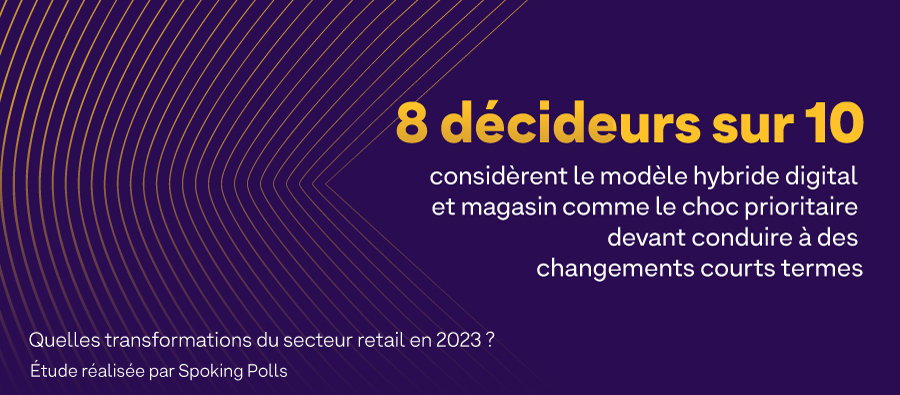
In a recent study published by Dékuple, 8 in 10 decision-makers consider the hybrid digital and in-store model to be the priority shock that should drive short-term changes, we asked Laurent Simonin, CEO of Smart TraffiK and oKube (Dékuple Group), for his view of the situation.
Companies today have to meet two challenges: the internal challenge of digital and physical coexisting, and the challenge of the in-store shopping experience.
Indeed, in many companies, some departments find themselves at odds and struggle to create a smooth path across all channels, wondering who owns the sale: digital, which promoted the product, or the store, which closed the transaction?
Another challenge for brands is to develop the in-store shopping experience in order to generate footfall at points of sale. New consumption patterns have particularly affected certain sectors. For example, toy retailers suffered from online competition, because the in-store shopping experience was often difficult for parents. Likewise, bookshops faced increased competition from online book sales. The textile sector has experienced upheaval in terms of economic positioning and user experience.
However, it is time to reconsider the idea that physical retail is doomed to disappear. We must understand that digital and physical, along with the various consumption channels, are now part of a new shopping experience.
This shift has led to a rethink of the consumer purchase journey, adopting an omnichannel vision that puts the consumer at the centre of the set-up. Interactions between distribution channels have become multiple and complementary, offering a smoother and more personalised shopping experience. This combination of channels has been observed to be the most fruitful, with an average basket 2.5 times higher for consumers who shop in a hybrid way. This demonstrates how important it is for brands to be present, without silos, at all their customers’ touchpoints.
In a hybrid consumption context, where companies must continue to analyse their catchment areas and their competition and promote their brands and products effectively, geomarketing is proving to be an essential tool. While digital consumption already offers a number of tracking and analysis tools, it is essential to bridge the gap between the physical and digital worlds in order to act strongly on optimising marketing performance. Geomarketing provides largely reliable insights and trends for better understanding customers and competitors.
Geomarketing consists of analysing, anonymously and after obtaining consent, aggregated geolocation data on individuals in order to understand where they come from and how they move around. Geomarketing therefore makes it possible to establish a genuine taxonomy or map of consumer movements, on a regular basis and in real time. Thanks to geomarketing, it becomes possible to know where consumers come from within a predefined area, to trace their journey and to find out whether they visit potential competitors, so that, ultimately, brands can anticipate, compare and adjust their media investments. It is also possible to correlate this information with sociodemographic data, such as age, gender, socio-professional category, etc.
Another benefit is the local dimension, with the main advantage of imagining ultra-local advertising, aimed at very precise audience targets corresponding to specific geographical areas. This valuable information on consumer movements makes it possible to optimise advertising campaigns, improve in-store footfall and increase revenue. It is important to stress that in a world where 80% of retail revenue is still generated at points of sale, geomarketing now makes it possible to apply digital analysis methods to the physical world.
Trained in finance, Laurent Simonin is in charge of strategy, communication and international development. A serial entrepreneur after about ten years in senior finance positions in communication groups, he founded a firm in 2002 to support the management of fast-growing startups, then tried his hand at the world of retail by opening a fitness club.
Laurent Simonin, CEO of Smart TraffiK and oKube (Dékuple Group)
In 2012 he decided to move into RetailTech. Smart Traffik was born! He served as its Managing Director until 2019 before becoming its Chairman.