

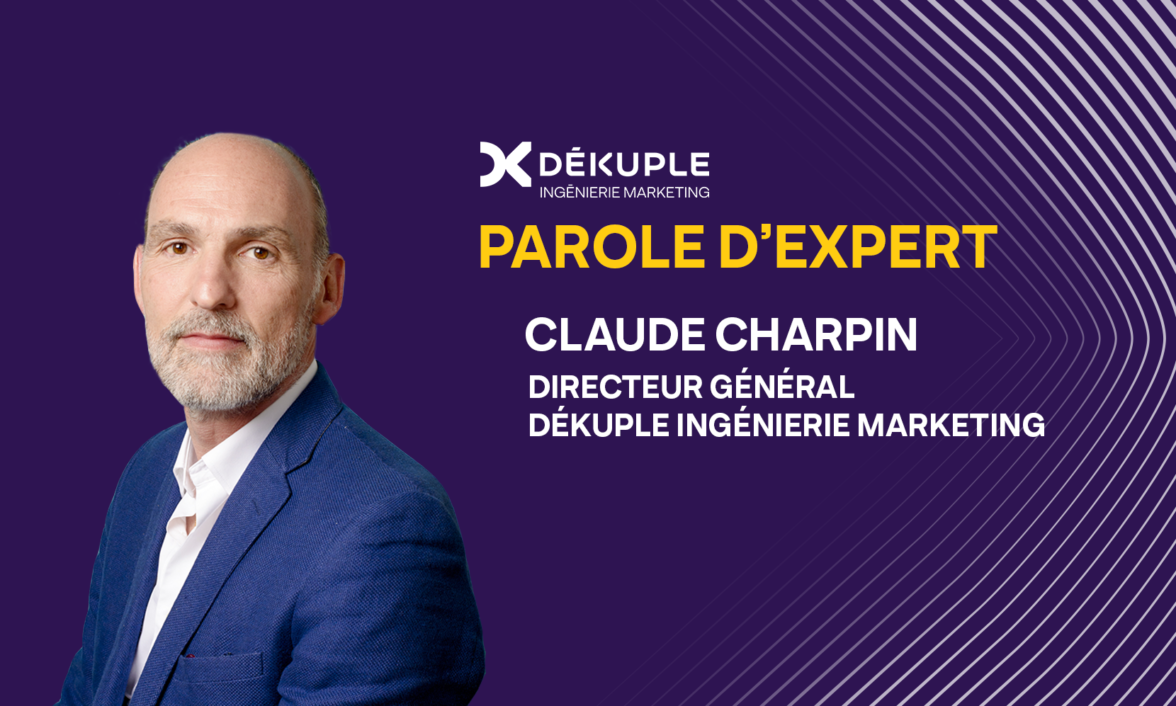

While strengthening loyalty is clearly one of the priorities to favour according to one of our recent studies, it is not the only rising trend in marketing services within companies. Claude Charpin, Managing Director of the Dékuple Ingénierie Marketing division, shares with us his vision of the new expectations of CMOs.
Many CMOs seem to have begun anticipating a tougher end to the year than expected. What is your analysis?
Claude Charpin: Of course, the economic climate seems to be deteriorating, with inflationary threats due in large part to the energy crisis and the war in Ukraine. We are seeing some projects postponed and, above all, our clients and prospects are asking a lot of questions about their 2023 marketing plan. CMOs are under strong pressure to demonstrate the effectiveness of marketing investments. They face demands that may seem contradictory: demonstrating short-term results while continuing to work on brand development. The latter is longer term and its results are harder to demonstrate. In this crisis context, the CMO will have to optimise their investments and demonstrate their contribution to the company’s business performance.
Precisely, how can CMOs better reconcile managing their brand over time with the need for short-term performance?
Claude Charpin: Contrary to what is often stated, these two objectives are not contradictory; they are even complementary and must be worked on in a consistent and simultaneous way. When these two elements are combined, they help build the brand’s trust and credibility, attract and retain customers, and therefore grow sales.
In both cases, it is first essential to know your customer targets well. Today we have very powerful tools and data to better understand who brands’ customers are. To optimise investments, it is vital to start with this type of study in order to design suitable messages and creative work, rolled out consistently across communication and marketing campaigns.
It is then necessary to find the right balance between brand building and sales activation, depending on the brand’s starting point.
A well-known brand that has built trust with its consumers could, for example, reduce top-of-funnel investments during this period and capitalise on its brand to grow sales and loyalty. It can, for example, set up loyalty actions by offering gifts to its best customers. This will help develop emotion, which is the most important force for growing sales in the long term and increasing profits.
Conversely, less well-known brands will need to keep working on their awareness to optimise their performance. They will be able to activate “economical” top-of-funnel channels such as digital, native advertising, influence, or social networks. Brand investments will feed trust and, in passing, improve the returns of performance operations, and therefore acquisition costs.
In one of the results of the study that Dékuple recently carried out, we note that CMOs will devote a larger share of their budget to loyalty.
Claude Charpin: Yes, it is a great classic in a period of slowdown or crisis. CMOs anticipate a difficulty ahead in recruiting new customers, with, in particular, rising acquisition costs. They therefore want to capitalise on existing customers to retain them and develop complementary sales.
Loyalty is often seen as a complex project, requiring the long and costly implementation of technological tools. It is often possible to move much faster by federating various initiatives that already exist in the company within a coherent, marketed programme, or by setting up emotional loyalty operations, which will contribute as much to developing trust and emotion with the brand as to growing sales in the medium term.
Beyond loyalty, what other major marketing services trends do you anticipate?
Claude Charpin: We anticipate 3 major trends for 2023.
The first concerns the retail sector. The rise in paper costs and the introduction of “Oui Pub” will force players to find new ways to replace the printed flyer and to generate traffic in their points of sale.
The second concerns performance measurement. CMOs will indeed increasingly have to justify their investments. It is necessary to put in place new methodologies and new means to measure the contribution of the various actions to the growth of the company’s business. This performance measurement concerns top-of-funnel indicators as much as those of performance campaigns.
Finally, sustainable development is gradually permeating society and consumers’ concerns. It is increasingly a business issue for companies, even an issue of changing the business model. Marketing Directors will therefore gradually have to integrate this dimension into their products and services, as well as into their communication. They will have to imagine a more circular economy, where trust will become more important than commitment.
A graduate of Telecom Paris in 1990, Claude Charpin began his career in telecoms before moving into consulting in 1996 at PWC Management Consultant, then A.T.Kearney as CRM & E-Business Director. In 2003, he joined Groupe Spir Communication, where he was Deputy Managing Director of Regicom, in charge of Operations and Sales. He joined e-TF1 in 2009, where he held the position of Deputy Director for CRM, Online Gaming and new businesses, then Dékuple in 2012 as Deputy Managing Director in charge of Business Development. He is now Managing Director of the group's Marketing Services division.
Claude Charpin, Managing Director, Dékuple Ingénierie Marketing