


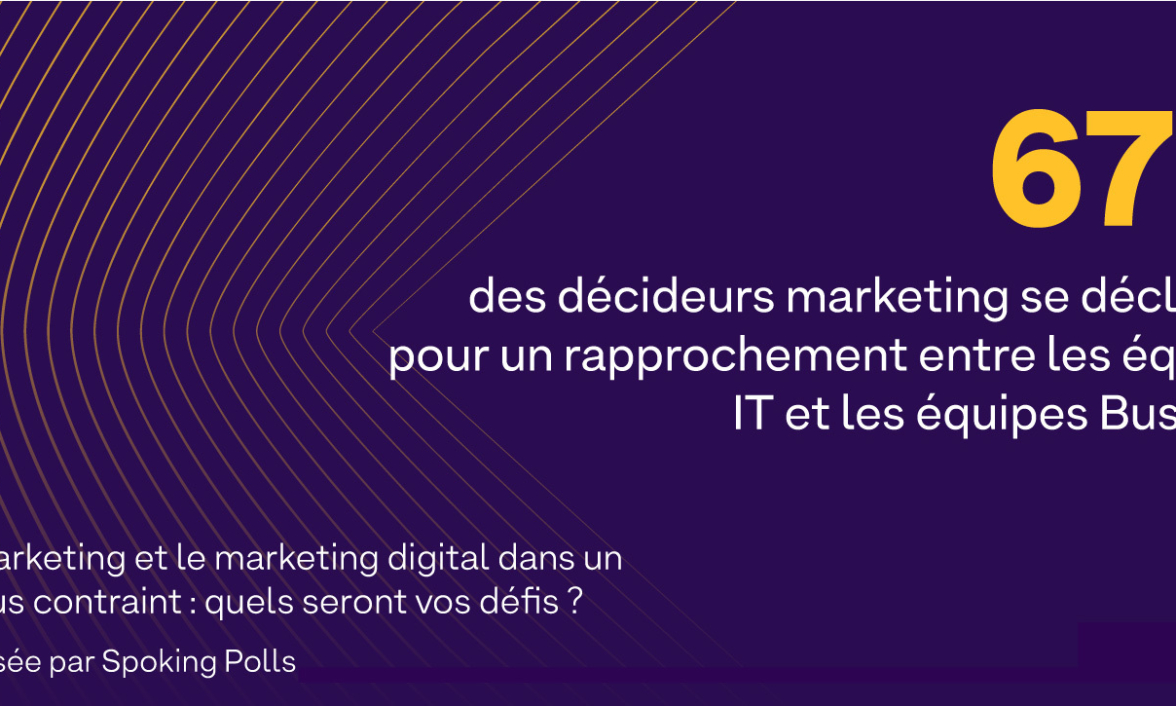
According to the Dékuple study, 67% of marketing decision-makers are in favour of bringing IT and Business teams closer together.
The opposition between Business and IT is nothing new. If we take a step back, we can see that over the past twenty or thirty years, advertisers have constantly questioned the role of IT. A few decades ago, advertisers had IT teams that were very inward-looking, focused on the back office, tools… “Tech” was driven far more by cost reduction than by the services to be provided to customers.
Many players wanted the cost of the IT department to stay below 1% or 2% of revenue. The IT department was seen as a necessary evil, an infrastructure that had to cost as little as possible, hence the subsequent outsourcing to India, for example. But then, with the emergence of digital, many companies began to produce technologies that were visible to customers. IT came out from behind the scenes. Hence the arrival of this question: what is the value of the IT department and of the technology it produces? This shift brought Business and IT closer together. We have moved on – and the transition is still under way – from a cost-centred vision to a value-centred vision.
Towards a Customer department?
Ultimately, the whole marketing and tech team comes together to serve the end customer. Some, like Club Med, have decided to merge their IT department into a hybrid department. Depending on your business, this can be an inspiring model.
A word of caution, however, before merging Marketing with Digital or IT: make sure the Marketing team itself is properly aligned, rather than scattered across varied objectives (media, CRM, shops, etc.), as is still very frequently the case, with internal rivalries over budgets. The CMO, in order to progress, must also keep acquiring new data and technology skills. This assumes that they have a free hand, time to train and, no doubt, a term of office lasting a little more than 18 months, which is the current average. Another way of reorganising would be to set up a Customer Department: it would reconcile all the acquisition and loyalty challenges, break down the “channel” prism that prevents customer-centric thinking, and put in place “seamless” omnichannel approaches. The aim is then to bring together all the necessary expertise around the customer.
Thomas Faivre-Duboz is co-founder of Converteo, a digital and data consulting firm with more than 350 consultants. He supports many General Management teams in transforming their business through data. He regularly speaks at conferences on digital and data issues, as a lecturer at HEC and as a senior lecturer in digital/data/e-commerce at leading business schools, incubators, training institutes, etc.
Thomas FAIVRE-DUBOZ, Partner & Co-founder of Converteo