
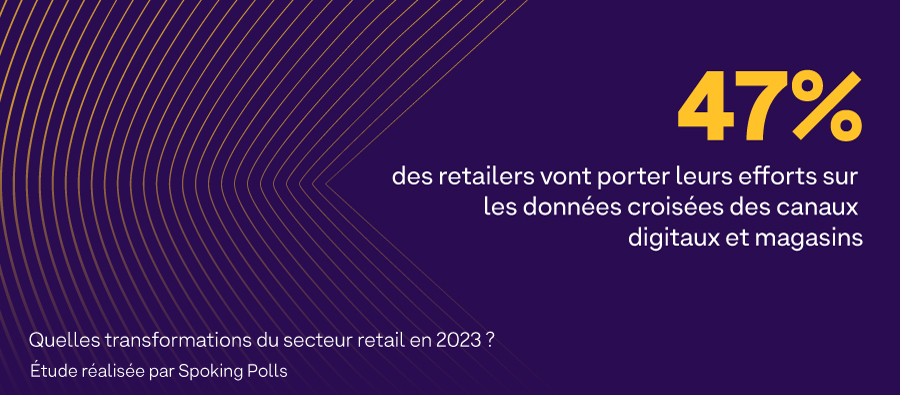
In a recent study published by Dékuple, 47% of retailers will focus their efforts on cross-referenced data from digital channels and stores, we asked Stéphane Bernal, Partner in charge of the Acquisition division at Agence Dékuple, for his view of the situation.
The retail sector has to deal with increasingly omnichannel consumption. Brands face the challenges of boosting in-store visits and understanding how digital channels and physical stores interact to influence consumers’ purchasing decisions. According to the Dékuple x Spoking Polls study, 47% of retailers have identified cross-referenced data from digital channels and stores as a key area on which they will concentrate their efforts.
Analysing cross-referenced data from digital channels and stores gives retailers a more complete understanding of the customer journey. By combining data from online purchases, in-store visits, social media interactions and other channels, retailers can trace the different stages of the customer journey and identify the touchpoints that most influence purchasing decisions. This in-depth knowledge makes it possible to target marketing efforts better and to offer a more consistent and personalised customer experience. However, as the number of channels increases, it becomes harder and harder to determine which ones really bring value. This is why it is essential to measure the effectiveness of all your marketing programmes and to find your most profitable marketing mix. Return on investment (ROI) is an essential indicator for measuring the effectiveness of your investments.
Moreover, the gradual disappearance of printed flyers will force retailers to adapt their media mix with new solutions that fit catchment areas as well as customer types.
Among the first measures used by retailers is a strategy of collecting their own customers’ contact details. This allows them to contact customers directly, more regularly, through email or SMS campaigns, to inform them of new products and promotions. The second measure is to develop numerous campaigns on Meta, Facebook and Instagram, in display, on the Google network of course, through email and SMS prospecting campaigns, SEA and SEO, but also via digital catalogues.
Another advantage is that it is very easy to measure the impact of these digital media on online sales with KPIs such as impression rates, number of impressions, cost per sale or acquisition cost. Measuring the performance of digital media in physical points of sale is more complex. In this case, new technological solutions make it possible, either through GPS positions from apps with internet users’ consent, or through boxes, to determine the impact of each lever and its contribution to a customer’s journey and in-store visit. The retailer can then arbitrate its budgets and optimise its visits and its ROI.