


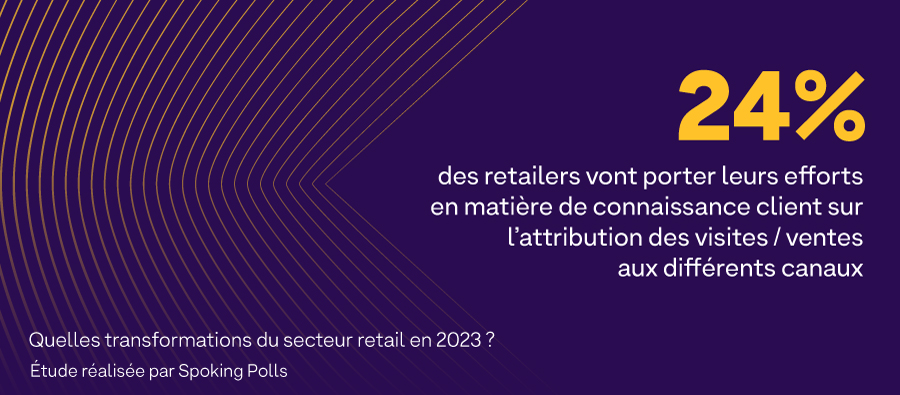
In a recent study published by Dékuple, 24% of retailers will focus their customer knowledge efforts on attributing visits and sales to the different channels, we wanted to ask Jérémie Levy, Senior Partner & Managing Director at Converteo, for his perspective on the situation.
In an ever-changing landscape, retailers must constantly adapt their approach to better understand and meet their customers’ expectations, but also to optimise media investment. One of the keys to achieving this lies in the ability to attribute visits and sales accurately to the different sales channels. Measuring the performance of Marketing budgets is undergoing structural changes linked to the importance of omnichannel journeys and the near disappearance of third-party cookies. To address the challenges of omnichannel measurement and privacy, Marketing Mix Modeling (MMM) remains the most reliable method for making strategic trade-offs on marketing investments.
MMM requires detailed historical data on sales, advertising spend and other market variables, with at least 2 to 3 years of data. It makes it possible to analyse the impact of each marketing channel on sales, measure the effectiveness of each advertising campaign and optimise the allocation of advertising budgets to improve profitability. The duration of a Marketing Mix Modeling engagement varies according to the complexity of the data and the company’s objectives. In general, allow several months to collect and analyse the data, and several weeks to carry out the modelling and draw recommendations from it. However, the time required may vary depending on the resources available and the size of the company.
Once the MMM is complete, companies have valuable insights with which to adjust their marketing strategy. This generally includes changing the budgets allocated to each marketing channel, by optimising the allocation of advertising resources, or adjusting prices and promotions. Actions depend on the results obtained and can be put in place as soon as possible, in order to improve marketing performance quickly and effectively. Depending on the granularity of the data, a budget optimisation can be proposed by product category and/or store segment.
Industrialising MMM models can help companies maximise their profits and better understand their performance. Data and business experts can help industrialise data collection (a critical but time-consuming and error-prone task), and support teams in making use of the results while providing useful, value-adding recommendations. This industrialisation allows MMM to be more than a one-off ad hoc study, and to become one of the pillars of the strategic management of marketing budgets.